How to self-manage a rental property in the UK (2026 guide)
Self-managing saves you the 10 to 18% a letting agent takes, but only if you have a system. Here is what the job involves, in the order you will meet it.
More UK landlords are managing their own properties. The reasons are obvious: letting agent fees often take 10 to 18% of the rent, and much of what an agent does is admin you can handle yourself with the right tools. The risk is just as obvious. The law hasn't got any simpler, and a missed certificate or an unprotected deposit can cost far more than the agent ever did.
This guide walks through what self-managing actually involves, in the order you'll meet it.
1. Know your legal duties before anything else
Whoever manages the property, the landlord is legally responsible. Before you advertise, make sure the safety and paperwork basics are in place:
- Gas safety record every 12 months from a Gas Safe registered engineer, if the property has any gas appliances.
- Electrical Installation Condition Report (EICR) at least every five years.
- Energy Performance Certificate (EPC) rated E or above in England and Wales.
- Smoke and carbon monoxide alarms that meet the rules for your nation.
- Deposit protection in a government-approved scheme within 30 days (30 working days in Scotland).
Our landlord compliance checklist covers every item, with the differences between England and Scotland.
2. Set up your systems on day one
The difference between a stressful self-managed let and a calm one is almost always organisation. Before a tenant moves in, decide where each of these will live:
- Documents: tenancy agreement, certificates, inventory, deposit paperwork, insurance.
- Renewal dates: gas safety, EICR, EPC, insurance, licences, and the reminders that go with them.
- Rent: how rent arrives, how you'll spot a late payment, and how you record it for tax.
- Repairs: how tenants report problems, and who you call for each trade.
- Communication: one written record of what was said, so nothing depends on memory or a lost text.
A spreadsheet and a shared folder can work for one property. Beyond that, most landlords use software that keeps documents, dates, rent and repairs together. That's what Panta was built for.
3. Find and reference the right tenant
A good tenant makes self-managing easy, and a bad fit makes it miserable. Advertise on the major portals (most accept private landlords through low-cost listing services), describe the property honestly, and screen consistently:
- Identity and, in England, Right to Rent immigration checks.
- Income or employment references, and affordability (rent is commonly kept around 30 to 40% of income).
- A previous-landlord reference.
- A credit check, with the applicant's consent.
Apply the same criteria to everyone. In England the Renters' Rights Act makes it unlawful to refuse tenants because they receive benefits or have children.
4. Get the tenancy agreement and move-in right
In England, new tenancies are now assured periodic tenancies, with no fixed term (see our Section 21 guide). In Scotland, use the Scottish Government's model Private Residential Tenancy agreement as your starting point.
On move-in day:
- Give the tenant copies of the gas safety record, EICR and EPC, plus deposit prescribed information.
- Test the smoke and CO alarms with the tenant present and record that you did.
- Complete a check-in inventory: room-by-room photos and notes that both of you sign. It's your best evidence if there is a deposit dispute later.
- Take meter readings and give the tenant contacts for emergencies.
5. Run repairs like a professional
Repairs are where self-managing landlords win or lose their tenants' trust. You're legally responsible for the structure, exterior, heating, hot water, sanitation and installations, and urgent problems (no heating, no hot water, leaks, electrical danger) need fast action.
A simple process that works:
- Tenants report in writing with photos, so you can judge urgency without a visit.
- You get at least one quote for anything non-trivial (two or three for bigger jobs).
- You approve, the contractor books a time directly with the tenant, and the work is signed off with photos.
- The invoice is filed against the property for your tax return.
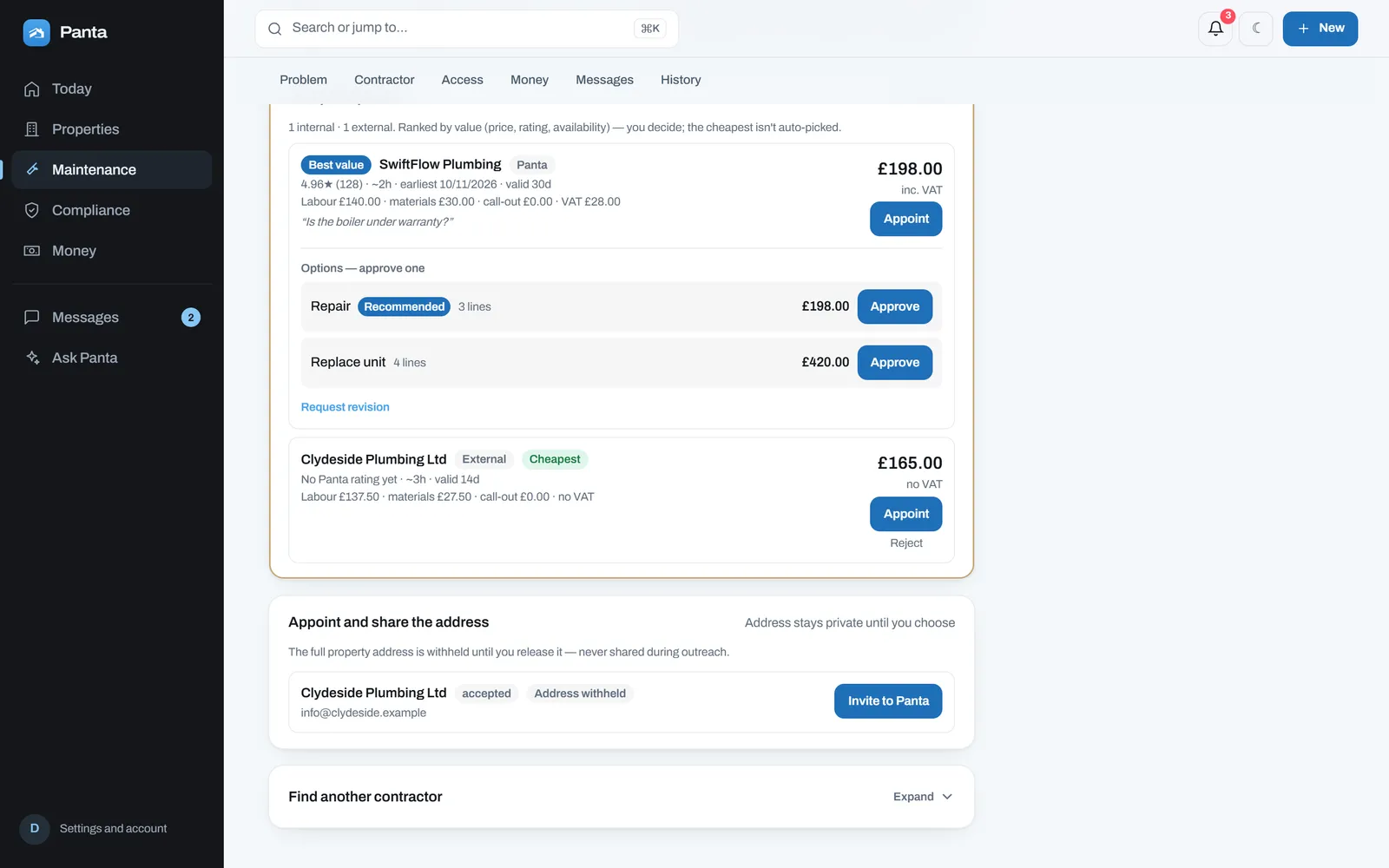
See exactly how this works in Panta, from the tenant's report to the contractor's invoice, in how a repair works.
6. Inspect regularly, with notice
Routine inspections every three to six months catch small problems (a dripping trap, early condensation) before they become expensive ones. You must give written notice: at least 24 hours in England and 48 hours in Scotland. Many landlords now let tenants carry out a guided photo inspection on their phone between in-person visits. It's less intrusive, and it builds a dated photo record. Here's how inspections work in Panta.
7. Keep on top of rent, money and tax
Record every payment in and every cost out against the right property. Allowable expenses include repairs, letting costs, insurance, accountancy and (within the rules) finance costs. From April 2026, landlords and sole traders with qualifying income over £50,000 must use Making Tax Digital for Income Tax, keeping digital records and sending quarterly updates to HMRC. That threshold drops to £30,000 from April 2027 and £20,000 from April 2028.
8. Know when to get help
Self-managing doesn't mean doing everything yourself. Use qualified trades for gas and electrical work, take legal advice before serving any possession notice, and consider an independent inventory clerk for high-value lets. The aim is to keep control and cut agent fees, not to cut corners.
Frequently asked questions
Is it legal to manage my own rental property without an agent?
Yes. Any landlord can self-manage in the UK. You take on the same legal duties an agent would carry out for you, including safety certificates, deposit protection and repairs. In Scotland you must also be on the Scottish Landlord Register before you let.
How much time does self-managing a rental take?
For a single, well-maintained property with a settled tenant, most landlords spend a few hours a month: chasing the odd repair, checking rent and keeping certificates in date. The busy periods are finding a new tenant and handling an urgent repair.
What do I need before a tenant moves in?
At minimum: a valid gas safety record (if there is gas), a current EICR, a valid EPC, working smoke and carbon monoxide alarms, a written tenancy agreement, a protected deposit, and a check-in inventory with photos. In England you also need to carry out Right to Rent checks.
How often should I inspect my rental property?
Many landlords inspect every three to six months. You must give proper notice: at least 24 hours in England and 48 hours in Scotland, and visits should be at a reasonable time.
Every property, looked after.
Repairs, certificates, rent and documents in one place. Start free with up to 3 properties, no card needed.